
Balancing Gym Goals with a 9-to-5 Routine
The hardest part of getting fit while working full time is rarely the workout itself. It is the calendar. Work meetings run long, commuting eats into the day, dinner has to happen, and sleep cannot be treated like an optional hobby.
Still, a 9-to-5 schedule can work in your favor. It gives shape to the week. Once training has a clear place in that shape, the gym stops feeling like one more thing to squeeze in and starts becoming part of the routine.
The goal is not to train like someone with unlimited free time. The goal is to build a plan that respects real life, produces progress, and does not fall apart every time work gets busy.
This post is for general fitness education, not medical advice. If you have health concerns, pain, or a medical condition, talk with a qualified professional before changing your exercise routine.
Start with a realistic definition of success
A common mistake is building a workout plan for the most motivated version of yourself. That version wants five gym sessions, home-cooked meals, perfect sleep, and a long stretching routine every night.
Real life usually has other plans.
Good fitness planning starts with the week you actually have. That means looking at work hours, commute time, family responsibilities, errands, social plans, and your energy patterns. A plan that fits 80 percent of your weeks will beat a perfect plan you abandon after 10 days.
For many full-time workers, three focused workouts per week is a strong starting point. That might sound modest, but it can support muscle growth, strength, better conditioning, and improved consistency when the sessions are well planned.
A realistic goal could look like this:
Lift weights three days per week
Walk 20 to 30 minutes on most days
Prepare simple meals for workdays
Sleep at a consistent time during the week
Track progress without obsessing over every detail
This kind of plan has room for life. That matters because the best routine is the one you can repeat when work is calm and when work is demanding.
Choose a workout time you can protect
There is no perfect time to train. Morning workouts, lunch workouts, and evening workouts can all work. The best choice depends on your schedule, energy, commute, and gym access.
The key is choosing a time you can protect with the least resistance.
Morning workouts work well for predictable days
Morning training gives you a major advantage. Work has not had a chance to interfere yet. Once the workout is done, it is done.
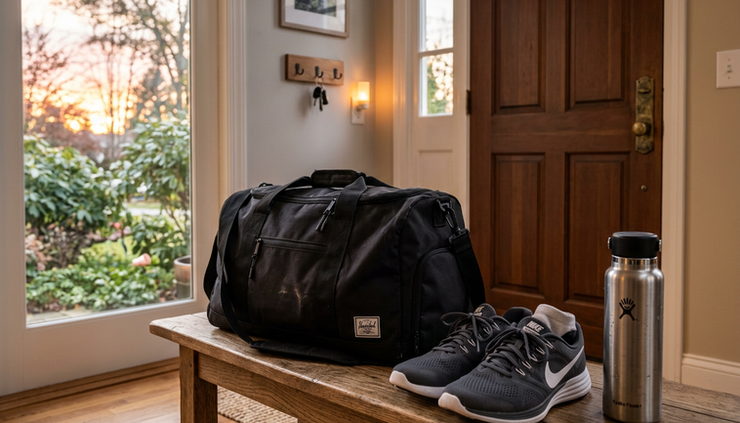
This works best if you can prepare the night before. Lay out your clothes, pack your bag, prep breakfast, and put your water bottle where you cannot miss it. The fewer decisions you make at 6:00 a.m., the better.
Morning sessions do not need to be long. A 45-minute strength workout before work can be enough if you follow a clear plan and avoid wandering from machine to machine.
A simple morning structure might be:
5 minutes of warm-up
30 minutes of strength training
5 to 10 minutes of conditioning or mobility
Quick shower and breakfast
The tradeoff is sleep. If an early workout means cutting sleep short every night, the plan will backfire. Move bedtime earlier or choose a different training window.
Lunch workouts work if the gym is close
A lunch workout can break up the day and keep evenings free. It works best when the gym is near your workplace or home, and when your job allows a reliable lunch break.
The main challenge is time. You need a tight plan. This is not the moment for a long warm-up, four different machines for the same muscle, or a 20-minute chat in the locker room.
Lunch workouts are ideal for:
Full-body strength sessions
Short conditioning workouts
Mobility work
A brisk walk outside
Keep a small kit ready if lunch training is part of your week. Pack a towel, deodorant, a change of clothes, and easy post-workout food. Small details decide whether this habit sticks.
Evening workouts work if you manage the transition
Evening workouts are popular because they do not require waking up early. They also give you a way to burn off stress after work.
The risk is the post-work slump. Once you sit on the couch, the gym becomes much harder.
The solution is to reduce the gap between work and training. Go straight to the gym if possible. If you work from home, change into workout clothes as soon as the day ends. Treat that change like a switch.
A useful rule is to avoid negotiating with yourself after work. Decide in advance what counts as a gym day. When the day arrives, follow the plan.
Build workouts around the basics
A busy schedule rewards simple training. You do not need a complicated split or a long list of exercises. You need a plan that covers the main movement patterns and lets you progress over time.
For strength training, focus on these categories:
Movement pattern | Examples |
Squat | Goblet squat, back squat, leg press |
Hinge | Romanian deadlift, hip thrust, deadlift |
Push | Bench press, push-up, shoulder press |
Pull | Row, lat pulldown, assisted pull-up |
Core | Plank, dead bug, cable chop |
Carry or conditioning | Farmer’s carry, sled push, bike intervals |
A full-body plan three days per week can work very well for someone with a 9-to-5. It trains each major area often enough without asking you to live at the gym.
Here is a simple weekly setup:
Day | Training focus |
Monday | Full-body strength |
Tuesday | Walk or light cardio |
Wednesday | Full-body strength |
Thursday | Rest or mobility |
Friday | Full-body strength |
Saturday | Optional cardio, sport, or longer walk |
Sunday | Rest and prep for the week |
This schedule leaves room for recovery. It also gives you chances to move even on non-gym days.
Keep the workout short and repeatable
A great weekday workout usually has a clear beginning, middle, and end. You should know what you are doing before you walk through the door.
For example:
Warm up for 5 minutes
Use a bike, treadmill, light rowing, or dynamic movement.
Train one lower-body lift
Choose a squat or hinge pattern.
Train one upper-body push
Use a press variation.
Train one upper-body pull
Use a row or pulldown.
Add one core or conditioning finisher
Keep it short and controlled.
You can rotate exercises every few weeks, but do not change everything constantly. Repeating movements helps you practice, measure progress, and gain confidence.
Progress does not require dramatic workouts. It requires enough effort, enough recovery, and enough consistency.
Make food support the routine
Training and nutrition are connected, especially when workdays are packed. If you skip breakfast, rush through lunch, and arrive at the gym underfed, workouts will feel harder than they need to.
You do not need a perfect diet. Start with simple anchors.
A solid workday eating pattern might include:
A protein source at each meal
Fruits or vegetables during the day
Carbs near workouts if they help your energy
Enough water before late afternoon
A planned snack to avoid vending machine meals
Protein is especially useful because it supports muscle repair and helps meals feel more filling. Common options include eggs, Greek yogurt, chicken, tofu, turkey, fish, beans, cottage cheese, protein shakes, and lean beef.
Carbs are not the enemy of weekday fitness. They can help fuel training, especially if you lift after work. Rice, oats, potatoes, whole-grain bread, fruit, and pasta can all fit into an active routine.
The practical move is planning. You do not have to meal prep every single meal in matching containers. Even preparing two protein options, cooked rice, chopped vegetables, and a few grab-and-go snacks can make the week easier.

Protect recovery like part of the program
Work stress counts as stress. So do hard workouts, poor sleep, long commutes, and busy weekends. The body does not separate gym stress from life stress as neatly as a calendar does.
That is why recovery has to be built into the plan.
Sleep is the big one. Most adults feel and perform better with a consistent sleep routine. If you train hard but sleep poorly, you may notice low energy, weaker workouts, worse cravings, and slower progress.
Recovery also includes:
Taking rest days without guilt
Walking on off days
Eating enough to support your training
Managing caffeine so it does not hurt sleep
Stretching or doing mobility work when you feel stiff
Reducing workout intensity during unusually stressful weeks
A useful mindset is to treat recovery as productive. Rest days are not missed opportunities. They are part of the process that lets training work.
If you feel run down for several days, adjust. Do fewer sets. Use lighter weights. Swap a gym session for an easy walk. Getting back to normal quickly is better than forcing a hard workout and losing momentum for a week.
Use systems instead of willpower
Motivation is helpful, but it is unreliable. Systems are better.
A system is anything that makes the desired action easier and the unwanted action harder. For Balancing Gym Goals with a 9-to-5 Routine, systems matter because the day already demands a lot of mental energy.
Try these:
Pack your gym bag the night before
Put clothes, shoes, headphones, towel, lock, and water bottle in one place.
Use a fixed training schedule
Do not decide each day whether you feel like working out. Decide once, then follow the plan.
Keep backup workouts ready
Have a 20-minute option for busy days. Short workouts keep the habit alive.
Set a minimum standard
On low-energy days, show up and do the warm-up plus two main exercises. If you still feel bad, leave. Most of the time, you will finish more than you expected.
Track only what helps
Write down exercises, weights, reps, and how you felt. Avoid turning tracking into a second job.
The point is to lower friction. When the plan is easy to start, consistency improves.
Plan for busy weeks before they happen
Every work routine has crunch periods. Deadlines, travel, school events, holidays, and long days will happen. A strong fitness plan makes room for them.
Instead of quitting during busy weeks, switch to a maintenance plan.
A maintenance week could include:
Two full-body workouts instead of three
Shorter sessions with fewer sets
More walking and less intense cardio
Simple meals instead of full meal prep
Earlier bedtimes when possible
Maintenance is not failure. It is a skill. It keeps you connected to the habit until your schedule opens up again.
The same applies to travel. If you cannot get to a gym, use bodyweight movements, hotel gyms, resistance bands, or walking. A few sets of split squats, push-ups, rows, planks, and step-ups can keep you moving.
The mistake is thinking a disrupted week cancels all progress. It does not. Progress comes from the pattern over months, not from one perfect week.
Make weekends help instead of hurt
Weekends can either support your goals or quietly undo your weekday effort. That does not mean you need to live like a monk from Friday night to Sunday night. It means making a few choices that protect your momentum.
Use weekends to reset:
Shop for groceries
Prep two or three easy meal components
Wash gym clothes
Review your workout plan
Schedule training times for the next week
Get outside for a longer walk, hike, or bike ride
If you enjoy eating out, plan around it. Have a protein-rich meal earlier in the day. Drink water. Stop when you are satisfied. One restaurant meal is not the problem. A full weekend of random choices can make Monday feel harder.
Weekends are also a good time for longer, lower-pressure movement. A hike, pickup game, bike ride, or long walk can improve fitness without feeling like another workout to complete.
Know when to push and when to scale back
A balanced routine has both effort and restraint. Some days you will feel strong and should push for a little more weight or an extra rep. Other days you will feel flat and should focus on good form and finishing the session.
Learn the difference between normal resistance and true fatigue.
Normal resistance sounds like:
“I do not feel like starting.”
“The gym feels inconvenient today.”
“I would rather go home.”
True fatigue feels more like:
Poor sleep for several nights
Unusual soreness that affects movement
Dizziness or feeling unwell
Sharp pain
A sudden drop in performance across multiple workouts
Push through normal resistance with a smaller first step. Put on your shoes. Drive to the gym. Start the warm-up.
Scale back when your body is sending stronger signals. Fitness should add to your life, not drain every bit of energy from it.
The routine that lasts wins
Balancing gym goals with a full-time job is not about building the most intense plan possible. It is about building a routine you can repeat through normal workweeks, stressful weeks, and imperfect weeks.
Start with three workouts. Keep them simple. Protect your training time. Eat in a way that supports your energy. Sleep enough to recover. When life gets busy, shift to maintenance instead of quitting.
The best plan is not the one that looks impressive on paper. It is the one you can still follow next month.



Comments